|
Proud Link Alliance staff stand in front of their station buildings, with Te Waihorotiu above and Karanga-a-Hape below.
|
|
Kia ora
Welcome to the final Karanga-a-Hape and Te Waihorotiu newsletter.
It has been quite a journey since the first CRL newsletters were published in November 2019. In total, each station has produced almost 80 newsletters, all of which you can view here by clicking on the station name and selecting Archives. The first combined Te Waihorotiu and Karanga-a-Hape newsletter was published in April 2025.
Together, these newsletters form a fascinating record for anyone interested in the project, its challenges, milestones, initiatives and celebrations. From the early days of demolition and service relocation through to breakthroughs, architectural finishes, and testing and commissioning, they document the major steps that have shaped the stations you see today.
A huge thank you to the crews who built the CRL, often heading to work in the dark and returning home in the dark. The stations, tunnels and track they leave behind are a testament to their hard mahi and skill, and something we are all immensely proud of. And a big thank you to our neighbours, who have shown patience, graciousness and good humour through disruptive and trying times.
This final newsletter is a highlights reel of our work over the past six years. It’s a bumper issue with a large number of images, so feel free to get scrolling. Enjoy.
The Link Alliance Communications and Engagement team is out of the office for the Christmas/New Year break, returning the morning of Monday 5 January. If you need immediate assistance during the holiday period, please call our 24/7 freephone number on 0800 CRL TALK (0800 275 8255) to reach our security team. Alternatively, please email karangahape@linkalliance.co.nz and one of the team will respond on 6 January.
Link Alliance works notifications in 2026
We've completed all but minor works in and around Te Waihorotiu and Karanga-a-Hape stations this year, which was reflected in the reopening of Albert Street and Beresford Square.
In 2026, if we have any impactful works in and around the station, we'll contact those affected directly to let them know.
The focus of our 2026 programme is testing and commissioning (T&C) of station and rail systems, prior to handover to KiwiRail and Auckland Transport mid-year.
Most T&C work is not anticipated to disrupt station neighbours, however if you'd like to receive works notifications about T&C activity, please sign up for the Maungawhau Station works notifications online at https://www.cityraillink.co.nz/maungawhau-notifications-and-current-works
Sign up for Auckland Transport updates
With our Link Alliance newsletters now coming to a close, Auckland Transport will be providing ongoing project updates to station communities and Aucklanders via their channels. Use this link to signup to AT’s Rail network update newsletter, and follow @Auckland Transport on social media for future updates about the City Rail Link. (Note you will need to sign-in or create a new AT account).
Ngā mihi,
The Karanga-a-Hape and Te Waihorotiu Station teams.
|
|
City Rail Link 2025 Highlights Video
Before diving into the highlights from Te Waihorotiu and Karanga-a-Hape Stations, enjoy this highlights package from 2025, a year in which we achieved many major milestones, from the first successful test train journey through the CRL tunnel at the start of the year, to the completion of Beresford Square at Karanga-a-Hape and the re-opening of Albert Street to buses.
Click on the image below to watch the video.
|
|
Karanga-a-Hape Station highlights 2020
2020 was a year of identifying and redirecting pipes and ducting, Diaphragm wall installation, a start to mining, and navigating a global pandemic.
The image below from July 2020 shows the noise shed being constructed, which enabled mining activities to continue overnight. Beneath it, the access shaft provided the sole route for all plant, personnel and spoil to enter and exit underground. On the right of the image are the bentonite silos - relocated to Beresford Square in 2021- which supported construction of the 40 diaphragm walls surrounding Mercury Lane.
|
|
|
After several weeks of excavation, the access shaft reached its full 20-metre depth. Before the first eastward drive towards Mercury Lane, crews marked the milestone with a traditional blessing of St Barbara, the patron saint of tunnellers. The blessing and initial eastward drive are shown in the images that follow.
|
|
|
Above ground, crews began installing diaphragm walls around the footprint of the Mercury Lane entrance building. These walls formed a reinforced underground concrete box, allowing the team to safely begin bulk excavation.
|
|
|
At Beresford Square, much of 2020 involved the upgrade and relocation of existing services. In October 2020 the big red silos were relocated to Beresford Square to enable the installation of more than 30 diaphragm walls around the square, as seen in the images below.
|
|
Te Waihorotiu Station highlights - 2019 / 2020
December 2019: Utility investigations and relocations are well underway by the end of the year. The slot trench illustrates the complexity of the utility network on Albert Street. The relocation of services next to Bluestone wall will enable the wall to be deconstructed and moved a metre to the east.
|
|
|
June 2020: Piling begins along Albert Street for the construction of Te Waihorotiu Station.
|
|
Karanga-a-Hape Station - highlights 2021
2021 was the year excavation ramped up across four fronts. The Dame Whina Cooper TBM departed Maungawhau in May, en route to Karanga-a-Hape Station, while tunnelling crews mined the platform tunnels beneath Karangahape Road using two roadheaders and excavators, operating 24 hours a day, six days a week. Supporting this underground work, crews at the Mercury Lane and Beresford Square entrances excavated their respective station boxes.
|
|
|
The highlight of Q1 in at Beresford Square 2021 was building the 900mm thick concrete slab that forms the roof of the underground station. Construction openings in the slab enabled excavation to begin in earnest once this task was complete.
|
|
|
By the end of the year, excavation to the fourth underground level (out of seven) was complete, as seen above. To reach this stage the team poured over 3,100m3 of structural concrete, fixed over 900 tons of reinforcing steel and excavated 2,5000m3 of soil and rock.
|
|
|
Another highlight at Beresford Square in 2021 was the creation of the Pocket Park on the corner of Pitt Street and Karangahape Road. Established the same year as First Thursdays, it complemented the night markets and went on to become a regular stage for live bands and performances, including Cross Street Festival and Others Way, over the following three and a half years.
|
|
|
Excavation of the mined tunnels in the first half of 2021 came with increased urgency, driven by the knowledge that the tunnel boring machine (TBM) would soon begin its first drive and would need to break through into a fully excavated tunnel.
The TBM, Dame Whina Cooper, was launched from the Maungawhau site in May 2021. On 17 October 2021, the TBM achieved its first breakthrough into Karanga-a-Hape Station. The journey covered approximately 840 metres and took around five months to complete, including delays caused by the Covid-19 lockdown at the time.
After reaching Karanga-a-Hape Station, the TBM was pushed through the tunnel cavern to the northern end, ready to begin the final leg of its first drive to Te Waihorotiu Station. It eventually broke through into the Te Waihorotiu Station site in December 2021, marking the completion of the first tunnel.
|
|
|
Above: Breakthrough to Karanga-a-Hape station, October 17 2021.
Below: The TBM gantry makes its way through the station.
|
|
|
MERCURY LANE
Excavation activities were also the order of the day at Mercury Lane. At the beginning of 2021 the team were excavating the first underground level as seen below.
|
|
|
By the end of 2021, excavation of the station box was mostly complete. The images below show Mercury Lane in its fully excavated glory, with a worker looking down the northbound tunnel towards Te Waihorotiu in the first image. In total, 61,000 cubic metres of spoil were removed from Mercury Lane – enough to fill around 24 Olympic-size swimming pools.
|
|
|
Above: Mercury Lane entrance building – platform level. December 2021.
|
|
Te Waihorotiu Station – highlights 2021
April 2021: Te Waihorotiu Station construction moves underground. CRL Chief Executive Dr Sean Sweeney with then Auckland Mayor Phil Goff and Councillor Pippa Coom.
|
|
|
May 2021: Then Transport Minister Michael Wood (left) and then Auckland Mayor Phil Goff (right) press the button on the newly-assembled Tunnel Boring Machine. This marks the beginning of the TBM’s first journey from Maungawhau Station to Te Waihorotiu Station.
|
|
|
June 2021: At the intersection of Albert Street and Wellesley Street, work to construct the station roof slab are almost complete, ahead of Wellesley Street reopening in late June
|
|
|
June and July 2021: A dawn blessing to mark the significant milestone of Wellesley Street reopening to vehicles following the completion of utility relocations and station works at the intersection. The intersection of Victoria and Albert Street then closed, enabling utilities, piling and excavations to get underway in July.
|
|
|
July to December 2021: The Wellesley Street Building is coming along nicely. The first floor superstructure is complete and the second floor columns, beams, and flooring are underway.
Underground, from July to December, the concourse level was constructed from Mayoral Drive to Wellesley Street (pictured), with concourse construction also underway beneath Albert Street between Victoria Street and Kingston Street.
|
|
|
December 2021: We sent off 2021 with the arrival of the Tunnel Boring Machine (TBM) at Te Waihorotiu Station, marking the end of its epic first underground journey from Maungawhau Station.
Dame Whina Cooper, our TBM, completed her first journey with 1.6km of tunnel created between Maungawhau Station through to Te Waihorotiu Station (via Karanga-a-Hape Station).
|
|
Karanga-a-Hape Station – highlights 2022
|
|
|
MERCURY LANE
If 2021 was characterised by excavation, with activity ramping up across multiple fronts, 2022 marked a clear shift to structure. Large-scale concrete pours followed, with floors and walls formed throughout the entrance buildings. The same transition occurred in the tunnels, where permanent concrete linings were poured along their length.
The image below shows the recently poured bottom slab at Mercury Lane.
|
|
|
Preparation for the concrete pours required a large amount of reinforcing steel. The image above, typical of Mercury Lane in 2022, shows steel being installed for walls and floors. In total 2,100 tonnes of reinforcing steel was used at the Mercury Lane entrance building.
|
|
|
Pouring the permanent tunnel lining was a major focus in 2022, with 25,000 cubic metres of concrete used across the tunnels and cross passages. The image above shows different stages of the tunnel lining process. Beneath the blue PVC waterproofing layer sit a geotextile layer and the temporary supports of rock bolts and shotcrete, while the travelling tunnel formwork can be seen in the distance.
|
|
|
The image above shows the northern most cross passage in mid-2022, with permanent concrete lining underway. The image below taken from the same location in November 2025. Note the 40-metre escalator to Beresford Square in the right of the picture.
|
|
|
BERESFORD SQUARE
Concrete works were also a major focus at Beresford Square in 2022, with thousands of cubic metres of concrete transported deep underground. The image below shows concrete trucks lined up to feed the concrete pump.
|
|
|
July 2022: 33-metres below Beresford Square, steel fixers prepare the platform level slab. To the right of the picture is the northbound tunnel. At the top of the picture (near the crane) is the cross passage and landing point for the 40-metre escalator.
|
|
|
By the end of 2022 all the floors at Beresford Square had been poured, as seen above.
|
|
Te Waihorotiu Station – highlights 2022
February 2022: Our diaphragm wall rig (also known as a hydrofraise), affectionally called Sandrine, finished all her duties at Te Waihorotiu Station and the CRL project. She departed for a new construction job over in Singapore
|
|
|
February 2022: Steel galore! Above ground we have almost completed the column and floors of the second level of the super-structure (Wellesley Street entrance building). Steel reinforcing and concrete pours for the second floor columns continues. Third floor columns are also now up.
The station roof slabs have just been completed in the section outside Crowne Plaza Hotel.
The final props and walers have been installed in our northern excavation and excavation down to track level was also fully completed this month with 8600m3 of spoil removed.
|
|
|
April 2022: Above ground we have almost completed the columns and floors of the third level of the super-structure (Wellesley Street entrance building). The final level columns are also now up and being prepared for concrete pours.
|
|
|
April 2022: Our very own Garry from Te Waihorotiu Station hands back the symbolic Dame Whina Cooper hard-hat to Chantelle from the TBM team, representing the importance of tunneling safety across the project. This marked the relaunching of the TBM on her second journey from Maungawhau Station to Te Waihorotiu Station.
|
|
|
July 2022: It’s all about the rooves. 2262 concrete trucks later carrying 11,305 cubic metres of concrete, our team poured the last roof slab cast over the main station alignment down Albert Street and Mayoral Drive.
This month we also completed the Wellesley superstructure's concrete roof.
|
|
|
September 2022: The TBM makes its final breakthrough into the Te Waihorotiu Station site, marking the end of boring CRL’s twin-tunnels.
|
|
|
November 2022: Installation of the concrete façade "sky" and "earth" element panels is almost complete on the Wellesley Street building superstructure.
Inside, internal blockwork for the back-of-house station rooms and facilities is complete and plasterboard fit-out is well underway.
|
|
Karanga-a-Hape Station - highlights 2023
BERESFORD SQUARE
In 2023 the heavy civil construction of the previous years began to be replaced by fit out works, with escalators winched into place and a start to cabling. In total more than 800km of cables have been installed throughout Karanga-a-Hape Station.
|
|
|
In the first half of 2023, visitors to site in would have seen formwork for walls throughout the station entrances, as shown above at Beresford Square. The modular system uses reusable panels to support concrete while it is poured and cured, eliminating the need for bespoke plywood formwork.
|
|
|
2023 saw the start to construction of the longest escalator in the country, requiring specialised staff working from ropes and harnesses.
|
|
|
The image above shows the ticketing area at Beresford Square in October 2023. Note the elevator shaft behind the red scrim and cable trays on the left and right walls. The image below is taken from the same location two years later, showcasing the escalators, artwork and architectural fit out.
|
|
|
Steel framing for the Mercury Lane entrance building rose from the site towards the end of 2022. By August 2023, the framing was complete and the 9-metre Atua panels had been installed on the façade.
Underground at Mercury Lane during this period, escalator installation was underway. The image below shows the suspended escalator connecting the first underground level to the second.
|
|
|
2023 saw major changes in the tunnels. The tunnel lining was completed and more than 400 metres of platforms – 5 metres wide – were poured. By the end of the year, the team had laid rail, installed the housing for the platform screen doors, run cable trays along the tunnel ceiling and begun installing the glass reinforced concrete wall panels, as seen below.
|
|
Te Waihorotiu Station – highlights 2023
March 2023: The extension of the concrete running tunnel “boxes” from Waitematā Station to Te Waihorotiu Station has wrapped up – including all outer walls, central walls and box roofs located under Albert Street. This means that rail track is not far from being installed through Te Waihorotiu Station (it’s already being installed in the rail corridor between Waitematā & Te Waihorotiu).
|
|
|
June 2023: Freshly laid concrete at the corner of Victoria & Albert Streets.
|
|
|
July 2023: Above the tunnels, the team has completed back-filling Albert Street with granular material and building back up to road level. In August, the area was asphalted and local access traffic returned to the road.
|
|
|
August 2023: We returned the first completed section of upgraded footpath on Victoria Street West for public use (between Albert and Federal Streets). Pictured here is the final basalt paving stone being laid in this block etched with the location finder ‘Albert Street’, alongside our proud crew.
|
|
|
September 2023: Celebrating a huge CRL milestone. The full rail track connecting all CRL stations from Maungawhau to Waitematā has been installed in the first of the two rail corridors. Pictured here are members of the rail systems team locking into place the final rail clip, within Te Waihorotiu Station.
|
|
|
September 2023 The station's ceiling wraps up into our seven skylights - located at street level to let natural light into the underground station. At street level the skylight boxes will eventually be surrounded by garden beds.
|
|
|
September 2023 The station's ceiling wraps up into our seven skylights - located at street level to let natural light into the underground station. At street level the skylight boxes will eventually be surrounded by garden beds.
|
|
|
November 2023: Final surfacing is now underway at the Victoria / Albert Street intersection and traffic returned in December.
|
|
Karanga-a-Hape Station - highlights 2024
|
|
|
MERCURY LANE
By the end of March, installation of all 130 panels at the Mercury Lane entrance was complete, as seen above. Behind the scaffolding, work was underway to install the ‘sky element’ around the building. Six months later, in September, we celebrated the big reveal as the final scaffolding was removed, and the lights were switched on.
|
|
|
Inside the entrance building, fit-out activities continued in earnest. The image below shows a technician working on an escalator. In total, three banks of three escalators will take passengers to and from platform level, with directional flow adjusted to suit demand.
|
|
|
The image above shows the ticketing area in the foyer of the Mercury Lane entrance building, with architectural elements, such as shadowbox wall cladding (tinted glass) installed.
|
|
|
By early 2024 the roof to the entrance building had been installed, which helped provide an anchor point for the escalators to be installed, as seen below.
|
|
|
The service block at the rear of the station also took shape throughout the year as seen above in an image from December.
On top of the fit out work at Beresford Square, the team focused on the urban realm works outside of the station, with the image below showing paving works on the north side of the square. By the end of 2024, 40% of paving works were completed.
|
|
|
Work on the ceiling battens and cabling behind them continued throughout the year, as seen above.
|
|
|
At the start of the year paving works were yet to commence. By December, paving works were mostly complete, as seen below.
|
|
Te Waihorotiu Station – highlights 2024
January 2024: One of the key links between the underground and the natural atmosphere at the station is via an above-ground structure on Kingston Street. This structure is known as a plenum, and is part of the station-wide network of ventilation and fan systems to ensure station airflow is well-maintained. Several large fans – approximately as tall as a human – are now being installed into the station. These fans are directly linked to the plenum and natural air from outside.
|
|
|
March 2024: The first two 22 kilovolt transformers have been livened along with the first two low voltage main switchboards. These help distribute power where needed within the station once operational.
|
|
|
April 2024: We have completed installing thousands of aluminium fins onto the building's dark concrete, in a range of different colours. This upper façade design treatment is an expression of the tears of Ranginui (the sky father).
|
|
|
July 2024: The ambassador of France to New Zealand, Laurence Beau, commemorated the re-planting of the Harvey Tree and the reinstatement of its original plinth as part of our streetscape upgrade works.
|
|
|
July 2024: The concourse level fit-out is now over 90% complete and on the passenger platform, terrazzo paving has begun.
|
|
|
August 2024 Platform level fit-out is also now over 90% complete. Note the stunning design features of the cross beams, skylights and motifs.
|
|
|
September 2024: Aluminium rods are currently being installed as part of the Wellesley St entrance building’s feature ceiling. Hundreds of the rods are designed to mimic the stems of harakeke (reeds) and the movement of water – creating a rippled lighting effect
|
|
|
October 2024: The reinstatement of Auckland’s heritage bluestone wall is now underway. The wall was deconstructed in 2020 to enable Te Waihorotiu Station construction. Each of the approximately 1800 blocks were surveyed, numbered, and have been stored offsite for the past four years. Our stonemason contractor has now returned and is carefully reinstating the wall, block by block - up against the exterior of the Te Waihorotiu Station wall.
|
|
|
November 2024: Ready and waiting – Link Alliance supervisors Dimitri and Jeff take a quick break here on the Te Waihorotiu Station platform having just installed some of the final customer wayfinding signage.
|
|
Karanga-a-Hape Station - highlights 2025
This was the year we put the icing on the cake, marked by spectacular reveals and the proud return of upgraded community spaces.
|
|
|
The big news from 2025 was the arrival – and departure – of the first test train to Karanga-a-Hape Station. The 3.45-kilometre-long inaugural journey took two-and-a-half hours to complete, with technicians running numerous checks relating to tunnel clearance, power supply and signalling.
Since February, more than 16,000 kilometres have been clocked up in test train runs through the CRL tunnels.
|
|
|
Batten installation, cabling, lighting and PA system installation were key tunnel activities in the first half of 2025. Areas such as the northern most cross passage (above in April), where the irregular shape of the space left little margin for error, were particularly challenging. The image below shows the space in November. In the new year a curved screen will be installed where there are missing panels.
|
|
|
The big reveal. Above, before Labour weekend. Below, after Labour weekend.
Over the long weekend, during a scheduled block of line on the Auckland rail network, the protective coverings and temporary equipment that have lined the tunnel platforms throughout construction were finally removed, revealing the finished platforms for the first time.
|
|
|
Test trains continue to make regular trips through the station, as seen below.
|
|
|
MERCURY LANE
In May we started decommissioning the construction service area, downhill from the Mercury Lane entrance, which involved dismantling the noise shed, filling in the access shaft and asphalting works.
|
|
|
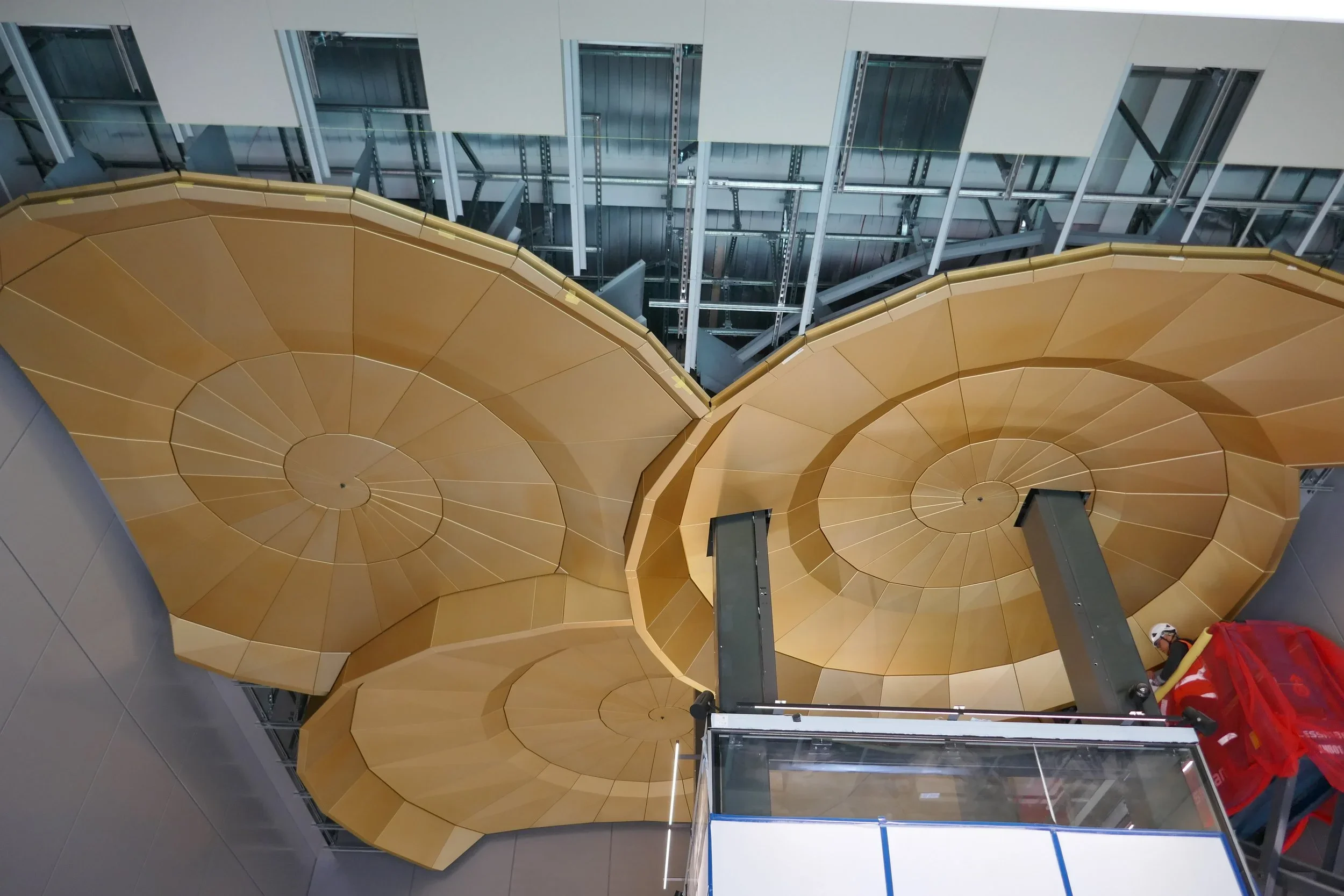
Throughout the year, the entrance building became increasingly impressive as architectural elements were installed. In June, the giant pupurangi (kauri snail) shells had only a few of the 225 anodised aluminium pieces in place, as seen above. By November, the installation, designed by artist and carver Reuben Kirkwood (Ngāi Tai), was complete, as seen below.
|
|
|
The escalator and landing areas underwent a similarly impressive transformation during 2025. The images below show the space in March and November, respectively.
|
|
|
Below: Cross passage through to the southbound platform. This is the view at the bottom of the escalators.
|
|
|
Throughout the year, Beresford Square continued to impress as key architectural elements came into view. In May, the Maramataka (Māori lunar calendar) installation was unveiled, as seen above and below.
|
|
|
And in October the beautiful bronze manaia were revealed on the vent pou, as shown below.
|
|
|
|